Hope and the Assumption
August 15, 2021
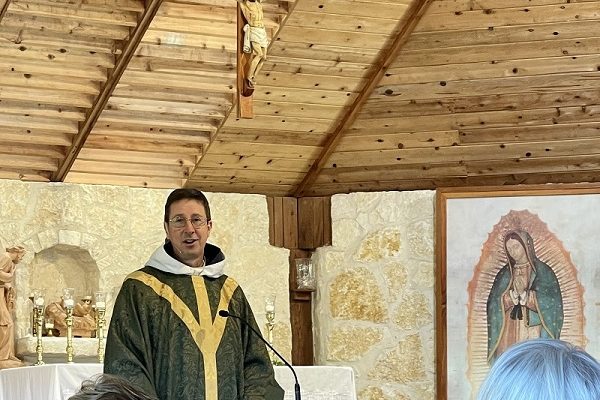
Our Blessed Mother’s Assumption is a great cause of hope for us. By this hope, we can already begin sharing the life of Paradise, even though we are still suffering on earth.
Our Blessed Mother’s Assumption is a great cause of hope for us. By this hope, we can already begin sharing the life of Paradise, even though we are still suffering on earth.
Today, many are losing their faith. Faith is hard. Is there anything you can do for your faith? Jesus, in this Gospel, show us the 3 key elements of an act of faith.
There are many important things that we can’t see. But, as Jesus shows in today’s Gospel, God gives us signs to lead us from what is visible to what is invisible. To His Real Presence.
We hear a lot about superheroes today. We wish someone would come to save us from evil. What if there was a real one…
In the storm that we are facing, it can seem as if the Lord is sleeping. Not paying attention. Doesn’t care. We feel like the disciples in the Gospel today.
What is a Covenant? Why is it so important to God? Why is it so important to your life?
The feast of the Holy Trinity leads us to the ultimate Mystery. We are called to share in it. We experience sorrow now, but Jesus wants to give us His Joy. Full. Without limit or end.
Our situation today, including in the Church, can seem very far from the graces of Pentecost. It may seem more like the Cross. And yet, there is a mysterious relation between the Cross and the outpouring of the Holy Spirit.
Did Jesus really rise from the dead? A cold case homicide detective, an atheist, uses his investigative techniques to see where the evidence leads.
“As the Father has loved Me, so have I loved you; abide in My love.” These simple words of Jesus, before His death, leads us into an infinite mystery: how much He loves you. Before being a call to give, Christians life is an opportunity to receive…infinite Love.
“He prunes so that it bears more fruit.” Jesus’s words shed a light of hope on hard parts of our life. And what we are experiencing in our world, and in the Church, right now. Even when something is done by evil, our Father can use it to help us bear more fruit. Fruit that will last forever…
Peter is facing powerful forces, trying to destroy Jesus and His Church. So are we today. Peter boldly proclaims Jesus. “There is salvation in no one else.” There is a solution to the worst problems of our world. There is only one: Jesus.
Easter is rooted in the Passover, the escape from slavery. Our world is cruelly oppressed by evil. How can we escape? St. Peter’s preaching shows us the 2 keys: recognizing our sin and trusting in Jesus’ Mercy. Repent, and believe the Good News.
Thomas, like us, struggles to believe because of all the evil he has experienced. Jesus reveals that the terrible darkness has become the path to the Resurrection, and the victory of Mercy. He calls for our cooperation: to trust in Him, to believe without seeing.
We will see much more that is bad and sad in our world. What has changed? The Resurrection of Jesus shows that this is only the beginning. It reveals the eternal fullness of life, of joy, that is open to us.
Jesus proclaims He is the King of Sorrows through the accounts of the mystic Maria Valtorta’s meditations on His Passion on the Cross.
Holy Thursday takes us back to the Hebrews oppressed in Egypt. How could they be free? God’s answer prefigures something mysterious: Jesus’ sacrifice. It is the realistic, effective solution to the oppression of will. The Holy Sacrifice of the Mass makes this present for us today.
Jesus is citing Psalm 22 from the cross. This Psalm shows the extreme trial of feeling abandoned by God. We also may experience that feeling; but this Psalm, from the agony of abandonment, leads us with Jesus to trust and hope in our God.