June 14, 2026
“PRAY therefore the Lord of the harvest to send out laborers into his harvest.” Each of us is called to help the great “harvest” of saving souls. But each in the particular way that God is calling him. Prayer leads us on this path.
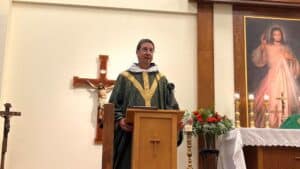
Some people have asked us for text versions of Fr. John Mary’s homilies, so we are sharing this AI generated transcript. It has not been reviewed by Fr. John Mary. The AI is very accurate, but not one hundred percent. If something seems significantly wrong, please consult original audio and let us know if there is a problem.
Also, it is good to keep in mind that this homily was intended to be listened to, not read. It was preached from notes, and there was no original written document. Nuance can be lost when it is only read.
Lastly the headings are not original but AI generated.
The Compassion of Jesus and the Call to Pray
When Jesus saw the crowds, he had compassion for them, because they were troubled and abandoned like sheep without a shepherd.
And is that even truer today, as the Lord looks out over his people and invites us to see things the way he sees things?
Then he said to his disciples, “The harvest is plentiful, but the laborers are few.” So what’s he going to say to the apostles?
We might expect him to say, “Do something, fix it, get busy,” but he says something very different:
“Pray therefore the Lord of the harvest to send out laborers for his harvest.”
So the first thing he is asking them to do is to pray. Why would he ask them to pray? First of all, because by praying they
begin to see also the way he sees; they begin to see things more the way God sees things. It is also recognizing that only
God can fix this situation. Only God can give the grace needed, even to respond to this situation. Our prayers can help others
respond, but also, by praying, we can discover what the Lord is asking each one of us to do—our own call, our own mission in
this situation.
This gospel is showing what he was asking the apostles to do: he is sending them out on their special mission. The apostles
are the sacred ministers, and so they have a very important role as pastors of the Church. Then there are their successors,
the bishops and other ministers of the Church. But that’s not the only way, that’s not the only response.
St. Faustina’s Vision of Jesus on the Cross
I’d like to come back to this experience of St. Faustina. I’ve often mentioned this, but I think it’s good to come back to it today.
St. Faustina recounts, in paragraph 1184, that one night she sees the Lord—she has a vision of God himself, of Jesus himself.
How does she see him? She sees him on the cross. She says from his hands, feet, and side the most sacred blood was flowing.
What would that be like—not just to see a crucifix, but to see Jesus himself transfixed and dying in torture on the cross?
This wasn’t just a moment; she says it lasted some time. Imagine the intensity of that experience. Then Jesus spoke to her from
the cross. He said, “All this is for the salvation of souls.”
So as we saw Jesus in the gospel looking out over all these souls who were troubled and abandoned like sheep without a shepherd,
on the cross he is saying, “All this is for the salvation of souls. Consider well, my daughter, what you are doing for their salvation.”
What would it be like to hear Jesus from the cross say that? Imagine him saying that to you: “Consider what you are doing for
the salvation of souls,” especially when it is Jesus dying on the cross saying that to you. I sometimes think: where is
“salvation of souls” on our priority list, on our to‑do list? People talk about a bucket list—things they want to get done—
but where is “salvation of souls” on that?
Jesus’ Response to St. Faustina: Hidden Martyrdom
St. Faustina answered, “Jesus, when I look at your suffering, I see that I am doing next to nothing for the salvation of souls.”
So it seems to her like she’s doing almost nothing. But what’s striking—and this is the passage I especially wanted to highlight—
is the Lord’s response to her.
He says, “Know, my daughter, that your silent day‑to‑day martyrdom in complete submission to my will ushers many souls into heaven.”
She feels like she’s doing next to nothing compared to what he is doing, but he responds by saying that her “silent day‑to‑day
martyrdom in complete submission” to his will is ushering many souls into heaven.
First of all, notice that he calls it “martyrdom.” St. Faustina doesn’t die a martyr; she dies of a disease in her bed. She dies
relatively young, but she’s not venerated as a martyr. Yet Jesus is speaking of her martyrdom, and if anybody knows what
martyrdom is, it’s Jesus. He says that what she is doing right now is a martyrdom.
The Nature of Silent, Daily Martyrdom
She’s truly, in his eyes, a martyr. And what type of martyr, what type of martyrdom is this?
He says it is “silent,” so it’s not something dramatic. It’s not something that many people notice. It may be very hidden;
in fact, it might be so hidden that even she doesn’t realize all that she’s going through. It is “silent.”
Then he says “day‑to‑day.” It’s not just a moment. I’ve shared this word before about the person who said,
“I don’t think I could ever be a saint, except maybe a martyr, if they killed me quickly.” That sounds like a good way to go.
But this is not a quick martyrdom. This is a day‑to‑day, long, drawn‑out “When is this ever going to end?” martyrdom—and that
may often be much more difficult, especially when it’s alone.
It’s kind of like what they talk about as the Chinese water torture—just drops of water, but by building up and building up and
building up, it becomes a terrible torture. Sometimes life is like that. It’s not one dramatic thing, but a long, long,
drawn‑out ordeal.
Then he says: “silent day‑to‑day martyrdom in complete submission to my will.” And that’s the key: she is doing his will.
She’s not choosing her own will; she’s accepting his will. He says, “in submission to my will.” So it’s not so much something
that she is doing, but what she is accepting—submission to his will. That’s the key: submission to his will.
Some people God calls one way; some people he calls another. But the key thing is that it be according to his will.
That’s what makes it so powerful.
The Hidden Fruitfulness of Doing God’s Will
How powerful is it? He says it “ushers many souls into heaven”—many souls into heaven. This was not yet visible to her.
She might have had some glimpses, but most of the fruits were not visible to her. Those fruits are still ongoing.
That’s important, because this silent, day‑to‑day martyrdom often bears fruits that are not things we can see right away.
Many of the fruits we might not even see during our life. Yet he says these are fruits for the salvation of souls.
So he is on the cross for the salvation of souls, and she feels that she’s doing almost nothing. But he is saying that what she
is doing is very fruitful for saving souls. Her silent, day‑to‑day martyrdom in complete submission to his will is saving many
souls, even without her realizing it.
This is a good example of how people have different roles, different ways to respond to this great mission. But the central
thing is that it is always in accordance with God’s will.
Different Vocations in the Same Mission
The apostles had a role of preaching, of healing, of working miracles, of governing the Church. Think how different that was
from the role of our Blessed Mother.
She wasn’t called to go out preaching. The gospel doesn’t give any examples of her healing people. It doesn’t show her working
miracles. She, the Mother of God, doesn’t have a public ministry of working miracles. There was, of course, the great miracle
of the Incarnation worked in her, but her life was not a public ministry.
She was the greatest example of union with Jesus, but in her exterior life she was living the simple role of a mother—a mother
who was faithful to her motherhood to the cross, and who then continued her motherhood with the early Church, and we know
continues her motherhood today. We see how different her mission was from that of the apostles.
Another example is St. Joseph. St. Joseph wasn’t involved in any of what we would usually call “ministry.” But by his role as a
husband, his role as a father, and his work as a carpenter, he had an irreplaceable role in the great mystery of redemption,
the saving of souls.
St. John Paul II says that St. Joseph was the one to whose custody God entrusted his greatest and most precious treasures.
He is recognized as the patron of the universal Church.
What They All Have in Common
So what do all these very different examples have in common—the apostles, St. Faustina, our Blessed Mother, St. Joseph?
All of them were doing God’s will in the particular way that they were called. All of them were helping in this great harvest
of saving souls according to the special mission that each one had.
Today, as we celebrate this Mass, it’s an opportunity for us to pray to the Lord of the harvest and to bring all the needs of
his children today to him. As we do that, it makes us more aware of these needs, especially this greatest need:
the salvation of souls.
We can offer our work, our prayers, our sacrifices, and our suffering. This Mass is an opportunity to ask the Lord:
“Lord, what are you calling me to do? What is your will for me in this great mission of saving souls?”
Amen.