May 17, 2026
Jesus was leaving to ascend in glory. Yet at the same time, He promised, “I will be with you always.” In the great trials of the Church today, more than ever, He wants us to know that He Himself is the Head of the Church. He will never abandon her.
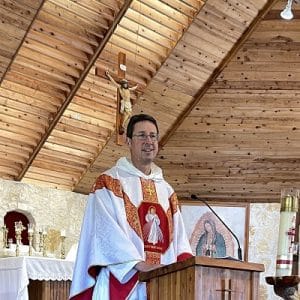
Some people have asked us for text versions of Fr. John Mary’s homilies, so we are sharing this AI generated transcript. It has not been reviewed by the Fr. John Mary. The AI is very accurate, but not one hundred percent. If something seems significantly wrong, please consult original audio and let us know if there is a problem.
Also, it is good to keep in mind that this homily was intended to be listened to, not read. It was preached from notes, and there was no original written document. Nuance can be lost when it is only read.
Lastly the headings are not original but AI generated.
The Ascension and the Trial of the Apostles
The eleven disciples went to Galilee, to the mountain to which Jesus had ordered them. When they saw Him, they worshiped, but they doubted.
This is the glorious Ascension of our Lord, but also, as Mother Magnan was saying, a hard trial for the apostles. How are they going to continue without Jesus there—without being able to see Him, hear Him, or touch Him as before?
In a different way, this speaks of a challenge that we are going through right now in the Church. A lot of people sense that there has been something wrong in the Church for some time—many years—something gravely wrong.
A Usurped Papacy and Confusion in the Church
As the messages that we’ve shared have said, now, beginning with Francis, first of all, on the very throne of Peter is a usurper. These usurpers are the ones who have named many, most, of the cardinals who are there today.
So what are we supposed to do? How is the Church going to continue if the very head of the Church on earth has been usurped, and even those who would choose the next head have been very compromised?
What hope is there for the Church? This is causing a lot of confusion and a lot of distress for people.
The feast we’ll be celebrating next week—Pentecost, the coming of the Holy Spirit—is a big part of the answer. But also what we’re celebrating today, the Ascension. We have these words of our Lord in the Gospel: “Behold, I am with you always, until the end of the age.”
It is striking that right as He is leaving and seems to be disappearing, He affirms that He will be with us always.
Christ’s Power and Headship Over the Church
The second reading we had today, from the Letter to the Ephesians, speaks even more clearly. This is the majestic prayer of Saint Paul:
“May the God of our Lord Jesus Christ, the Father of glory, give you a spirit of wisdom and revelation resulting in knowledge of Him.
May the eyes of your hearts be enlightened, that you may know what is the hope that belongs to His call, what are the riches of glory in His inheritance among the holy ones, and what is the surpassing greatness of His power for us who believe, in accord with the exercise of His great might.”
He emphasizes the power:
“Which He worked in Christ, raising Him from the dead and seating Him at His right hand in the heavens, far above every principality, authority, power, and dominion, and every name that is named, not only in this age but in the one to come.”
So He is above all others. There is no power, no authority, no spirit above Him. Today there is all this talk about extraterrestrials and special spirits, and that Jesus was just the forerunner and now there is going to come the great Messiah or something like that. This is saying very clearly: no. There is no one greater than Him—not now, not ever.
Saint Paul continues:
“He put all things beneath His feet…”
This is the key phrase I want to highlight today:
“…and gave Him as head over all things to the Church, which is His body, the fullness of the One who fills all things in every way.”
He gave Him as head to the Church, His body. We are part of that body. He is our head.
Christ the Living Head, Not a Distant Founder
The Catechism quotes precisely this passage in paragraph 792, and that section is entitled “Christ is the Head of this Body.” It is speaking about the Church: Christ is the head of this body, the Church.
Jesus is not like founders of other religions, who teach us things, who give an example, who perhaps organize a structure, and then leave. No. Jesus is with us. He is present. He is the living head of His Church. He is alive. He is with us. He is “God with us,” who is guiding us. He is in control. He is acting today in the whole Church: the Church militant here on earth, the Church in purgatory, and the Church already in glory.
As He says, “All power in heaven and on earth has been given to Me.” All power. He is the high priest who sanctifies. He is the teacher who guides us and teaches us the truth. He is the shepherd, the king, who governs His Church and leads it.
How Christ Guides and Provides for the Church
How does He guide the Church? The Catechism, in paragraph 794, says:
“Christ provides for our growth…”
It does not say “Christ provided” for our growth, as if it were only in the past. It says “Christ provides”—now—for our growth, because He is living.
“Christ provides for our growth, to make us grow toward Him, our head. He provides in His body, the Church, the gifts and assistance by which we help one another along the way of salvation.”
So He gives to His Church the gifts and assistance by which we help one another along the way of salvation. Saint Paul compares the Church to a body and each one of us to members of that body. Each one of us has particular gifts that are meant to be at the service of the whole body. Through that, it is our Lord Himself who is working through each one of us, with our different gifts.
Through His Holy Spirit He continues to act in the Church. One of the key gifts is the role of the hierarchy, the sacred shepherds, including Saint Peter and the other apostles and their successors: the popes and the bishops. The pope is the visible head of the Church, and the bishops are the local heads of each diocese.
There are many other ways that He provides for the Church: through the sacraments—like this Holy Eucharist that we are celebrating right now—through Scripture that we are sharing right now, through Tradition, and also through His action in the secret of our hearts.
He also acts through other ways, such as great manifestations like apparitions. We have Our Lady of Guadalupe as a great example, and His apparitions to Saint Faustina of Divine Mercy, and the many different gifts and charisms that He shares throughout His Church as He decides.
The Gift of Prophecy and God’s Sovereign Action
Among those gifts is the gift of prophecy. That is one that we feel He has been asking our community to be especially attentive to—the gift of prophecy. In the prophetic messages that He has shared with us, He emphasizes precisely this point: that He is acting, and He is sovereign in His freedom. All authority has been given to Him. There is nobody who can say to Him, “You can’t do that.” There is nobody who can put rules and limitations on what He can do. All authority is His. He acts with sovereign freedom, with absolute power.
The charism that He has asked for our little community is faith. But remember: it is not faith just so that we can act—though that is good, because faith helps us to act and to act better. It is, above all, faith so that God can act. It is the faith which opens the door to His own action.
He is sovereign, but in His divine providence He has associated His action with our faith.
One of the ways He has called our attention here at our little mission is through prophetic messages—one of the ways that He speaks, guides, encourages, and warns the Church.
The Present Crisis in the Papacy and Infiltration in the Church
To return to the situation we are in today, regarding the visible head of the Church—the papacy: He has said in these messages—I know these are very harsh words; I would not say them on my own—but He is the one who is saying them, and I do not want to be unfaithful. These are harsh words, but they actually explain a whole lot of things that are otherwise hard to understand.
It is hard to understand how a true successor of Saint Peter could say and do some of the things that we have been seeing recently. It makes a lot more sense if these positions have been usurped—usurped so that there is still an appearance that this is the true successor of Saint Peter, but no longer the reality. That is where the deception is.
There has been a long, patient infiltration into the Church, which the Masons have been working at for a long time, bringing in moral corruption, doctrinal corruption, liturgical corruption. This has infiltrated the Church. So we Catholics today are facing trials that the Church has never faced before. The Church has been through terrible trials, but we are facing trials that no other Catholics have had to deal with.
Our Inability to “Fix” the Church and the Need for Divine Intervention
So, how are we going to fix this? How are we going to fix this situation?
We are not going to fix it. We cannot fix it. And we cannot hope that the cardinals whom the usurpers have designated are going to be the ones to fix it.
But that does not mean there is no hope, because God Himself is the one who is going to save the situation.
The Catechism, in paragraph 793, says:
“Christ unites us with His Passover. For this reason we are associated with His sufferings as the body with its head, suffering with Him that we may be glorified with Him.”
So once again, the Catechism returns to something that we have been insisting on a lot: we, the body, are living with the Head the passion—now—of the Church.
I will say this again; I have said it many times: What was the solution to the death of Jesus? It was not that the apostles said, “Let’s have a synod. Let’s listen to everybody, gather together, set up commissions, and try to discern what we are supposed to do.” It was not the apostles, it was not the disciples, who solved this.
It was God Himself intervening with His power, which was so absolute that not even death could stop it.
So if the Church is living the passion of Jesus, that means the solution is not something that is going to come from us. It is going to come from His intervention—a divine intervention. That does not mean we have no part to play. We do. But it was Jesus who, in His divine power, rose from the dead.