September 14, 2025
We all encounter humiliation in our lives. What is the good news of how can it lead to true exaltation?

Key Points
- The Triumph of the Holy Cross.
- Jesus Himself gives the example.
- Accepting God’s will.
This is a computer-generated transcription that has been included to make the homily searchable. It has not been verified by the author.
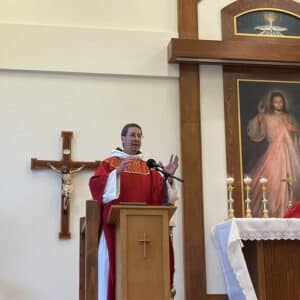
“Jesus humbled Himself and became obedient unto death, even death on a cross.” This second reading today brings us back to humility, and I’ve been talking about humility these past two Sundays. And so, when I was preparing these readings, and I felt the Lord drawing me to this passage, I thought, maybe that’s a little bit too much. We don’t want people to overdose on humility, but then I was reading the recent message from the Lord, where He said, “No children, humility, humility, humility. If you wish to live in the truth, you will need to live in humility.” And I was struck that humility three times, three times, and each time it’s all caps. So, I thought that was maybe like a sign from the Lord that it was good to come back to humility. In fact, the messages speak, that’s one of the topics that they come back to, over and over and over again. That’s especially important for our time. And in fact, life is full of humiliations, and some humiliations are visible to other people. Some humiliations, maybe other people don’t notice, but just we ourselves notice, like we’re trying to do something, and we fail. And I know the path of our little Mission of Divine Mercy has been full of humiliations. I was thinking of the first reading today. I like the first reading of today, where it says, “the Israelites with their patience worn out by the journey.” So, they’re sick and tired of this journey, and it says they’re complaining against the Lord, or against Moses. They said, “why have you led us out here to die?” And then they said they’re talking about the manna. They said, “we are sick of this wretched food.” So, they’re pretty disgusted as they say, they were with their patients worn out by the journey. So, there’s a lot of difficult paths today, but today we have this example of the feast of the Holy Cross. And that passage which I just read from St. Paul reminds us of a passage that we heard just two weeks ago in the Gospel, where our Lord said, “He who exalts himself will be humbled, but he who humbles himself will be exalted.” And we’ve heard that a lot in the gospel, but we have today in our Lord, the greatest example. And so, I wanted to focus on, I felt like the Lord has joined us to this passage, and I want to focus on three aspects of it. The first is that Jesus says, “he who humbles himself,” he who humbles himself, he doesn’t say he who is humiliated, he says he who humbles himself. That is, it’s an active form, actively humbling a self, ourselves. So, what does that mean to humble ourselves? Sometimes we might say, “Well, life humbles me enough. I don’t have to, I don’t have to do it anymore.” But what does Jesus mean by this? I think it’s helpful to see what it does not mean. If we look at the example of Jesus, Jesus does not hide His intelligence, His knowledge, His wisdom when He’s called to teach. He doesn’t pretend that He can’t work miracles or healings or has the power to cast out demons when He needs to. And especially, He does not deny His divinity, but He’s not doing it to exalt himself. He’s doing it when it’s in obedience to the Father’s will. So, what does He do? And the reading today shows us very clearly. It says, “He, though He was in the form of God, did not count equality with God a thing to be grasped. But He emptied Himself.” He emptied Himself. We often think of life as trying to fill ourselves, and it said, “He emptied himself taking the form of a servant, being born in the likeness of men and being found in human form, He humbled Himself and became obedient unto death, even death on a cross.” So, it says He humbled Himself and became obedient. You know, the charism of the Mission of Divine Mercy is faith so that God can act. And when the Lord guided us and told us that there were like, there are three core virtues that He wanted us to focus on. So one of them, obviously, is faith. But what were the two others? So, faith, because there’s so many important virtues, right? So many beautiful, important virtues. But the two others that He asked us to focus on were humility and obedience. The two that we have right in this phrase, He humbled Himself and became obedient. And so, I asked the question, what does it mean to humble ourselves? An example of Jesus, and I think the essential thing it means, it seems to me, at least with this example here, is to obey God’s will, to accept God’s will. So it’s not, first of all, trying to put ourselves down, but it’s accepting God’s will, instead of trying to impose our will. Humbly accepting God’s will, and that often involves humiliations. So, I think that’s the key. When it says, “He humbled himself,” that’s not trying to put ourselves down, but it’s obeying God with the hard consequences that that involves. And that’s a great, as I say, that’s a great act of humility, because our pride wants us to try to impose our own will. And the example our Lord gives is accepting in obedience, God’s will, even if it involves a lot of humiliation. Again, just to take the example of our little mission right now, the path that the Lord’s leading us on involves a lot of humiliations, and a lot of good people have felt that they’ve said goodbye to us, basically because they think we’re on the wrong path. It seems like a crazy thing to them, and the Lord told us that the day will come, in which He will make it clear that this is His will. But that day hasn’t come yet, and until it comes, there’s a lot of humiliations. So that’s the first point, he who humbles himself, and I think it’s accepting God’s will. And then he said, then what does it say? Then it says, will, He who humbled himself will. So just that word will, what does will mean? Will is talking about something in the future. So, it’s not yet here. So that calls for faith and hope, to believe and to trust in something that’s not here yet. And when will it be? I don’t know, it’s in the future. So, it says will, but it doesn’t say might be, could be. It says will. That means it’s in the future, but it is sure. It is certain, so that it takes faith and hope, but it is certain. And then the third point will be, what will be exalted. So, notice the difference. He said, he who humbles himself, so that’s active, and here he’s using the passive form. He doesn’t say, He who exalts himself, he says, will be exalted. So, he doesn’t say, he who humbles himself will exalt himself. He says he who humbles himself will be exalted, again the passive form. The world says, if you want to be exalted, you have to do it yourself, or you have to make a pact with satan, but you have to, you have to actively work for exalting yourself. And that’s often times the way the world works, and many people are willing to make a bargain or a deal with satan in order to achieve that exaltation. But here what the Lord says when He uses the passive form, it means that it’s not you who will exalt yourself. So, who will it be? Because in a world, there’s not a whole lot of people looking to exalt us. And so that’s why we often feel it’s basically a competition. I have to exalt myself, because no one else is going to do it for me. But here, Jesus says we’ll be exalted. So, who will do that? Who will exalt me if I don’t exalt myself? Who will exalt me? And so, Jesus is revealing that there is someone whose loving eye is always on you, who sees all the humiliations and injustices, who keeps a record of them, and who desires and has decided to exalt His humble children, and He will, and no one can stop Him. Of course, this requires faith, but what Jesus is saying is sure, unstoppable, and so that’s very good news. And we have the great example in Jesus Himself. He humbled Himself, and then what happened? It doesn’t say He Humbled Himself, then He exalted Himself. What does it say? Therefore, that same passage, it says, “Therefore God has highly exalted Him.” God, His father has highly exalted Him. So here we have the greatest example of the one who humbled Himself and is then exalted. Therefore, God has highly exalted Him, not just exalted Him, but highly exalted Him. And what does it mean when it says God doesn’t just exalt but highly exalt? What does highly mean for God, the Most High? We can’t imagine the exaltation that that is. It says, “God highly exalted Him and bestowed upon Him the name which is above every name, above every name that at the name of Jesus, every knee should bow, in heaven, on earth and under the earth,” – that is even the spirits of darkness have to recognize His name – “and every tongue confess that Jesus Christ is Lord.” He who humbled himself is Lord to the glory of God the Father. And so, on this feast of the Exaltation of the Holy Cross, we have the crucifix right behind us, and our Lord has gifted us with, – many of you are aware of that – with a relic, a little relic of the True Cross. So, on this feast with our Blessed Mother, who, as Mother Magdelene, said, will have the Feast of Our Lady of Sorrows tomorrow. But let us turn our eyes to our Lord Jesus. And so, I’m going to reread this passage again. “Though He was in the form of God, He did not count equality with God a thing to be grasped. But He emptied Himself, taking the form of a servant, being born in the likeness of men. And being found in human form, He humbled Himself and became obedient unto death, even death on a cross. Therefore, God has highly exalted Him and bestowed on Him the name, which is above every name, that at the name of Jesus, every knee should bow in heaven, on earth and under the earth, and every tongue confess that Jesus, Christ is Lord to the glory of God, the Father.” And so that same Jesus, promises us that everyone who follows Him, who humbles himself, accepting obeying God’s word, will be exalted. Amen.
KEYWORDS / PHRASES:
Numbers 21:4-9
Phillipians 2:6-11