January 19, 2025
This can represent the lack of joy and love in a marriage. And in our lives. What does this Gospel teach us?

- The first miracle of Jesus’ ministry was at a wedding.
- Inviting Jesus and Mary.
- Mary’s intercession.
- What is Jesus’s “Hour”?
- The abundant “wine” that Jesus gives.
This is a computer-generated transcription that has been included to make the homily searchable. It has not been verified by the author.
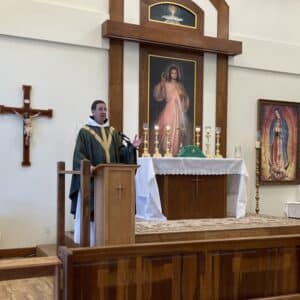
“When the wine ran short, the mother of Jesus said to him, they have no wine.” And John says, This is the first miracle that Jesus is working as He is beginning His public life. If you had to choose what should be the first miracle that the Savior of the world would work as He begins His public ministry, would you say, well, He should multiply wine? Isn’t there something more important for Him to do than multiply wine? Sometimes it seems like it’d be better that there, some situations, there’d be less wine than more. So why is He multiplying this wine? One thing that John’s Gospel shows, especially John’s gospel, is that a lot of times what Jesus does has a deeper significance than people realize at the time. And I think we have a good example here. We have, you know, there’s a lot of examples. For instance, when Jesus talks about bread, and people, just think of common bread, and then He speaks of the bread of life, or water with the woman at the well. And then He speaks of living water. And so there’s a deep meaning here, Jesus is coming. Jesus begins this first miracle at a marriage. And a sign of His love and blessing and now raising marriage to a sacrament of Holy Matrimony. And it’s not, it’s not like it’s a royal wedding of a very, like very prominent people. It’s just ordinary people. And so Jesus is coming to visit these simple, ordinary people as a sign of His love for each marriage. And but in this situation, Jesus doesn’t just come to the marriage, that would already be a great grace, but He comes to the marriage and then the Gospel says they have this situation where there’s no more wine. And as I said, often, especially in John’s gospel, we see that these simple things often have a deeper symbolism, like wine, which can be a symbol of the joy, the delight of love, but now the wine is lacking. And we know that in marriages, that joy of a loving union can be lacking in marriages, and it can be lacking in life. You know, there’s probably not too many of us who are complaining that we have way too much joy in our life. Joy is a lot of times in short supply in our world. And so this gospel has a lot of grace for couples, for marriages, but also for all of us. And it’s striking that when Jesus works this miracle, the wine is very good. They said, “You’ve kept the best wine until now.” And it’s a lot of wine. The Gospel says it’s about 150 gallons of wine – for this common people, that’s a lot of wine. And so it’s a sign that God has created us for abundant joy, joy beyond all imagining, joy that we call Beatitude, because it’s beyond any other experience of rejoicing together with God. And so this is as the head waiter says, “you’ve kept the best until last,” which is a sign that the best is yet to come for those who believe in Jesus. This abundance of joy the best possible, this overwhelming abundance of joy comes from Jesus, even though, following him on this our short time on earth is often very painful and difficult, but it’s to prepare this abundance of joy. And so this gospel not only reveals to us that God wants us to experience abundance of joy, but it also gives us some key guidance about how. And so one of the things we see here in this wedding at Cana is that they had invited Jesus and Mary. So that simple act is so profound; to invite into our marriages, into our relationships, into our life, to invite Jesus and Mary, and especially if both spouses do it, it becomes even much stronger to invite Jesus and Mary. And so this Gospel also gives us a light on our blessed mother’s role. One thing we see about Mary that this gospel shows is that she’s attentive, attentive to the needs of others. She could have said, “well, it’s not my problem. I’m not the one in charge of this marriage, so let them worry about it.” But we see that she’s very attentive, even to these very simple needs of this young couple. And so that’s a sign of our Blessed Mother, of the role that she continues in this image of Our Lady of Guadalupe, it’s a sign that she continues to be attentive to our needs, to the needs of her children. So she brings this situation to Jesus, and it’s interesting that Mary doesn’t tell Jesus what to do. A lot of times we want to do that, right? We want to tell God He should do this; He should do that. I want to tell God a lot of times what He should do. He doesn’t usually take my advice. But she doesn’t, she doesn’t tell Jesus what to do. She presents a problem to Him. She presents, very simply, the problem, but then entrusts Him to know what to do. And the first miracle is going to happen because of her, but how? But before He works the miracle, Jesus responds. And His response is mysterious. And so it’s hard to translate; there’s different translations. Sometimes it’s translated, what is there between you and I, “woman. what is there between you and I?” Or “women, how does your concern affect me?” For those of you are familiar with Maria Val Torta’s, ‘The Gospel as It was Revealed to Me,’ there’s a very helpful explanation there. I won’t go into it right now, but you could look it up. But some people think that Jesus is putting His mother off, kind of, but obviously He’s not, because he does work the miracle, so that’s a sign that He’s not putting her off, even though He has said, “My hour has not yet come.” So when two people know each other very well, they can communicate very simply, and they can understand each other in ways that other people on the outside might not understand. And we don’t know exactly how Jesus said this, what was His tone of voice, what was His body language or anything. So we have to be careful about misinterpreting it. Because no two persons have ever had a deeper union than Jesus and His mother. There’s a deep, mysterious depth of communion. And so this is one example in what seems to be a very simple exchange. So Jesus responds like that to her, but then He works the miracle, and it’s a sign of how powerful Mary’s intercession is, and that Jesus wants us to know how powerful her intercession is. And there’s another passage in ‘Poem of the man God,’ where St Peter wants something, and Jesus doesn’t want to give it to him. It’s a good thing of what Peter is asking for. So Peter turns to our Blessed Mother, and she ends up, our Lord, and ends up because of her intercession, giving it to Peter. And Jesus says, “It’s like you’ve discovered the weakness of God.” That’s how powerful the intercession of our Blessed Mother is, and she is concerned for us and Jesus loves all of us, but the power of her intercession is beyond all others. And it’s interesting that this miracle was not worked at Nazareth. That is, it wasn’t worked for, Jesus didn’t work this miracle for His own family. He wasn’t just like popping off with miracles, just to make the life of the Holy Family easier. This miracle was done for the benefit of somebody else. And so Jesus is obviously, in this Gospel, wanting to make our blessed mother’s role of intercession known, because she will share so deeply in His suffering, that He wants her to be the great Mediatrix of His graces. And there’s another lesson Our Blessed Mother gives. What she tells the servants is, “Do whatever He tells you.” So she’s sending the servants to Jesus. She’s sending the servants to obey Jesus. Mary always leads to Jesus, and some people are afraid that if they are too devoted to our Blessed Mother, that’s going to separate them from Jesus. But on the contrary, the closer we draw to Mary, the more she leads us to Jesus, to follow Jesus, to obey Jesus. That’s what Mary’s role is, to teach us to obey Jesus. So this Gospel highlights our blessed mother’s role in our life. And then there’s this mysterious word of Jesus who says, “My hour has not yet come.” What does that mean? “My hour has not yet come.” He’s faced with this situation. I mean, that’s kind of mysterious. He’s faced with this situation where the couple had this first crisis in their marriage, or could be a crisis, this lack of wine. And that’s a sign like of how a lack of joy that all the lack of joy, the lack of love that comes into our world because of the separation from God that sin causes. And so that behind this situation of the lack of wine, it can be a sign of the pain that sin brings into the world, that the separation from God brings into the world. So Jesus says, “My hour has not yet come,” at the beginning of His public life. And then John’s Gospel shows that at the Last Supper, Jesus says, “Father, the hour has come.” Now, the hour has come just as He’s about to enter into His passion. And so this is tying together this wedding at Cana with the Last Supper and Jesus passion. And we have the first reading, this beautiful first reading from Isaiah, which speaks of the spousal love of God for His people. It says, “No more shall people call you forsaken or your land desolate.” No more shall you be forsaken or desolate. And you know that’s something that we can experience in life, feeling forsaken, feeling desolate. He says, “But you shall be called My delight, and your land espoused for the Lord delights in you and makes your land His spouse. As a young man marries a virgin, your Creator shall marry you. As a bridegroom rejoices in his bride, so shall your God rejoice in you.” So this is speaking of a people and who have experienced feeling forsaken and desolate. And it’s revealing two great things. One, it’s revealing that God wants to draw His people, draw us Into a spousal union with Him. It says it very clearly. It says, “Your land shall be called espoused.” You know, the land of Israel represents the people of Israel, and the people of Israel is a prefiguration of the mystery of the Church. And so it’s speaking of God’s desire to call His people, His church, into a spousal union. We’ve often talked about this, but this is one of the most, this is a very clear passage, “your land shall be called espoused.” And He says, “And He makes your land His spouse.” And then, to make it very clear, says, “as a young man marries a virgin, your builder shall marry you,” and so speaking of this desire for God. So this is not just talking about a human marriage, but it’s talking about a human marriage is a reflection and a sign of God’s desire to call us into a spousal union with Him, to call each soul into a spousal union with Him, where He can give Himself fully to the soul, and the soul can respond by a total gift of itself to God. So that’s this great mystery, that Christian marriage is a sign of God calling us to espousal love. But then there’s something in some ways, maybe even more surprising. This passage from Isaiah doesn’t just say that “you will delight in the Lord.” That’s very logical that we should delight in the Lord because He is the greatest of good. But what it says is “the Lord delights in you,” and that’s what’s kind of mind blowing. “The Lord delights in you.” Of course, He’s not talking about you. He’s talking about better people than you, right? So, because that’s the way we feel; He couldn’t be talking about me. Maybe He’s talking about our Blessed Mother, but He couldn’t be talking about me. But this is, this is speaking to us of the love that God has. Well, not just the love, but it says, it doesn’t just say, “The Lord loves you.” He says, “delights in you.” And so it’s speaking to us also of the power of God’s grace and mercy to free our souls from sin by His sanctifying grace, so the Lord can delight in us, take joy in us. And again it says, and it doesn’t just say that one time, then later on, it says, “as a bridegroom rejoices in his bride, so shall your God rejoice in you.” “So shall your God rejoice in you.” So God doesn’t just save us so that He can take pity on us, but God’s grace, the power of His Holy Spirit, is so transforming that it gives union with the soul who responds to God, gives joy to God, intense joy to God. And so that’s part of this mystery, that God calls us to be so transformed from sinners by His grace and His grace and mercy that He rejoices in us. And we were just speaking recently about the wedding feast of the Lamb, that every Mass reminds us of the wedding feast of the Lamb. And so this very Mass that we’re celebrating, our Blessed Mother said, what did she say to the servant? “Do whatever He tells you.” And that’s what we’re doing in this Mass, in particular when we do what Jesus said, “Take this all of you, and drink from it, for this is the chalice of My blood, the blood of the new and eternal covenant, which will be poured out for you and for many, for the forgiveness of sins. Do this in memory of Me.” So the Mass is an opportunity to do as Mary said, to do what Jesus told us to do. And by doing that, we can receive His gift of love, the gift of love, which is already present in this sacrament of Holy Communion, as the servant said, “you have kept the good wine until now.” And it’s a sign that it’s in God that man experiences the greatest of joys. The mystics often talk about this, that the experience of when God gives them a foretaste on earth, of the joy of union with God. And so, in conclusion, this Gospel, which is both a very special Gospel for marriages, but also for all of us, because all of us are called to the wedding feast of the Lamb, to enter into the fullness of a spousal union with God. And so this we can follow the advice about the guidance of this Gospel of inviting Jesus and Mary into our lives, our families, so that Mary can intercede for us and help us to obey Jesus. And what does Jesus ask? Above all, what Jesus asks is that we receive His love and abundance. You know, the Mission of Divine Mercy is about faith so that God can act, but that faith is not just believing articles of the Catechism; that’s very important, but the faith is also believing, as St John says, in the love God has for us, for each one of us. So the more we believe in His love, the more we can receive His love. Because I mean that that’s just in any relationship, right? If there’s no trust, then that limits the love, but the more that limits the communion. But the more there is trust and faith – and of course, not, you know we have in a human relationship, you know we can’t trust completely, but in our relationship with God we can trust completely. And the more we trust, the more we believe and have faith, the more we can receive His love. The more we believe, the more we can receive His abundance of love. And so that’s what this very Mass, this very Mass that we’re celebrating, you know, and Mass can seem kind of like a routine thing that we go to, because God often does that, right? He hides under very ordinary appearances. In here – I wish we had a beautiful cathedral to be celebrating this in – but here we have kind of a makeshift, our little makeshift center here, but hidden behind those ordinary appearances is the sacred mystery, where Jesus invites us to receive in Holy Communion His very self, God giving His very body, given for us His blood poured out, His Soul and Divinity, that God has given the fullness of Himself, He is giving to us. That’s the sign of a spousal love. God gives Himself fully to us and is calling us in to a union with Him. And so I’ll end with that passage from Isaiah. “As a bridegroom rejoices in his bride, so shall your God rejoice in you.” “As a bridegroom rejoices in his bride, so shall your God rejoice in you.” Amen.
KEYWORDS / PHRASES:
John 2:1-5
Isaiah 62:1-5